
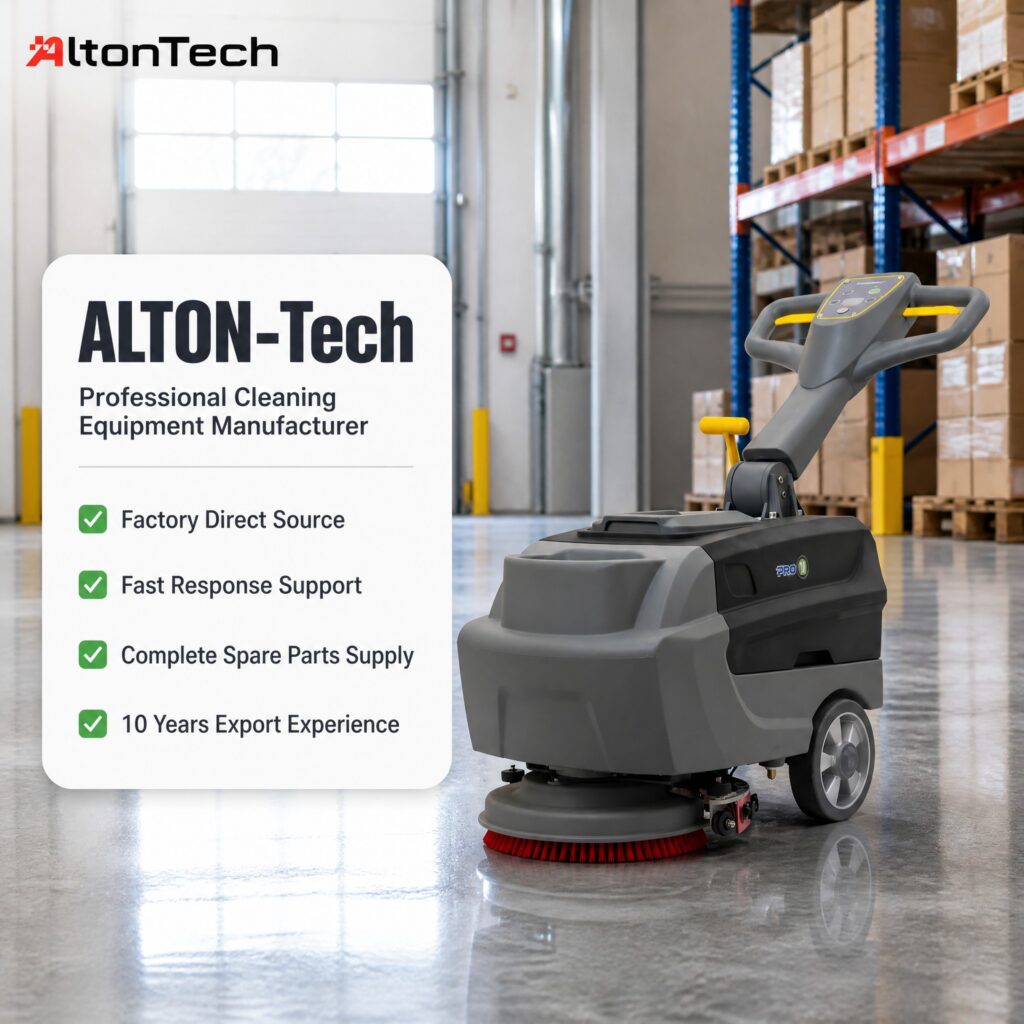
Choosing the right floor scrubber is critical for maintaining industrial hygiene and operational efficiency. With over 10 years of export experience, Alton provides professional advice for global buyers.
1. Evaluate Your Cleaning Area and Efficiency (m²/h)
Start by measuring the total surface you clean per shift and the time the operator actually has. Productivity is quoted in square metres per hour (m²/h): cleaning width multiplied by travel speed, minus time lost to refilling, draining and battery changes. A 500 mm walk-behind machine realistically delivers 1,500–2,000 m²/h, while a 700 mm ride-on can reach 4,000–5,500 m²/h. Size the machine so your daily workload sits at 70–80% of its rated output — that leaves headroom for traffic, obstacles and double passes in heavily soiled zones.
2. Match the Scrubber to Your Floor Type
Floor type determines brush pressure, pad selection and even whether a scrubber is the right tool at all. Sealed concrete and epoxy in warehouses and workshops work best with a medium-pressure disc brush. Polished tile and stone in retail or showroom areas need a soft brush or a white pad to avoid scratching the finish. Anti-slip safety flooring and rough textured concrete call for a cylindrical brush deck that sweeps debris while scrubbing. In food, beverage and pharmaceutical plants, specify stainless-steel components, chemical-resistant squeegee blades and machines rated for frequent washdown.
3. Walk-Behind vs. Ride-on: Choosing the Right Model
Walk-behind models suit areas under roughly 2,000 m², multi-storey buildings and sites where the operator must pass through standard doorways or manoeuvre in narrow aisles. For tight spaces, the compact Alton T2 is the perfect fit. Ride-on models become more economical above 3,000–5,000 m², where the operator covers long runs without fatigue; for large facilities like warehouses, the T8 ride-on model offers unmatched productivity (up to 5525m²/h). Also check ramp access, lift capacity between floors and where the machine will be parked and charged.
4. Key Specs: Battery Life, Water Tank, and Suction Power
Three numbers predict whether a scrubber survives a full shift. Battery life: a modern lithium-ion pack typically delivers 4–6 hours of runtime and accepts opportunity charging during breaks, while older lead-acid sets give 2–3 hours and need a full cool-down cycle — always compare runtime and recharge time together. Water tank capacity: solution usage runs about 0.05–0.1 litres per square metre, so a 60 L tank covers roughly 600–1,200 m² between refills; a recovery tank noticeably larger than the solution tank prevents foam and overflow. Suction power: measured as water lift or vacuum pressure, a strong vacuum picks up water in a single pass and cuts drying time, reducing slip risk in busy areas — look for water-lift figures above 1,200 mm and a straight, clog-free squeegee assembly.
5. Why Buying Factory-Direct from Alton Matters
By sourcing directly from our factory in China, you gain access to certified quality (CE, UKCA), fast technical response, and a complete supply of spare parts. Factory-direct supply also means your machine is configured for your market before shipment — voltage, plug type, documentation and language of the control panel — and that brushes, squeegees, hoses and batteries stay available for the entire service life of the unit instead of being discontinued by a distributor.
Explore our full range of products or contact us for a customized cleaning solution.
